
Prepare two (2) logical comparison maps.
[See: Making Logical Comparisons: Info Mapping]
Be prepared to explain your maps next class, 05.13.
Prepare two (2) logical comparison maps.
[See: Making Logical Comparisons: Info Mapping]
Be prepared to explain your maps next class, 05.13.
Can you write a paragraph with a good topic sentence? Let’s find out!
Continue reading
This is one of the highest rated talks on TED. Watch this talk and see if you can answer these two questions:
First discuss with your group, and write your answer below.
Assignments for Day 1, April 8, 2016
Continue reading
Credit Suisse numbers released in October 2010 show that the richest 0.5 percent of global adults hold well over a third of the world’s wealth. – See more at: http://inequality.org/global-inequality/#sthash.mMH7d4NB.dpuf
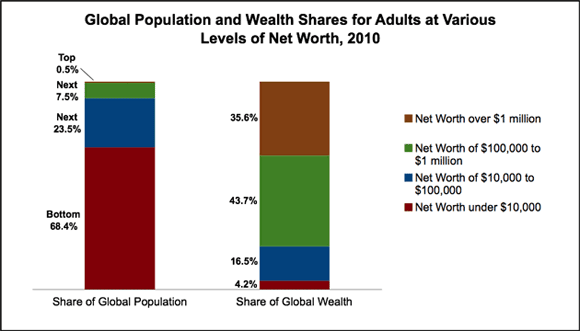
Source: Credit Suisse Research Institute Continue reading
CEFR-J Writing B2.1 Goal:
“I can write reasonably coherent essays and reports using a wide range of vocabulary and complex sentence structures, synthesizing information and arguments from a number of sources, provided I know something about the topics.”
What I am looking for is…
C = You came to class and tried, but…
B = You did everything okay.
A = You did most things well.
AA = D’s Mind Blown
What are “Global Issues” and how serious are they? Help me find out what you know and think before we get started. Continue reading
Technical reading is reading done for information, usually in your academic area of study. It is something you will do all your professional life. Technical reading in English will be especially important to your career.
If subtitles “aren’t invisible, you fail,” says Henri Béhar, subtitler of notable films such as Brokeback Mountain, Boyz in the Hood and Good Will Hunting. “The titles should subtly give people the impression that they are understanding the characters speaking, not reading words on the screen.” Trying to translate one language to another in the course of a film has challenges and limitations that apply to dubbing as well as subtitling — unlike literature which has the safety net of footnotes, film subtitlers have to make it work in the moment, all while trying to adapt wordplay and cultural references.
Once in a while, subtitlers do get their due. Jacqueline Cohen, responsible for all of Woody Allen’s films since 1989’s Alice, says that “whenever Woody comes to town, he always mentions that the reason his films are so successful in France is thanks to the person who does the subtitles.” No quick task, considering the talky nature of the prolific filmmaker’s almost annual releases. “Action movies average about 700 subtitles — Woody’s, between 1,500 to 2,000,” says Claude Dupuy, the director of subtitling at LVT Laser Subtitling, which handles more than 600 films per year.
At LVT and other companies, a person watches the film scene by scene, doing what’s known as spotting — marking time according to the timecode, the film’s official clock — the start and end point of each spoken line of dialogue. Then the subtitler goes to work, balancing the challenge of conveying meaning accurately within the confines of space and the roughly 1.5-second-long display allotted per subtitle. The reality is that despite the reputation of subtitling over dubbing as a form of cultural purity, the eye reads slower than the ear hears, meaning that more than a third of a film’s dialogue is sacrificed for what is most essential. The general rule is no more than 45 characters per line, even though widescreen movies could fit longer sentences (says Dupuy, “it shouldn’t be like watching tennis”).
There are logical rules as well, such as finishing a subtitle when a character stops speaking and not extending it over a cut, which can be disorienting. Good subtitles work with the rhythm of the scene, based on accurate spotting that captures that timing.
 インクス
インクス 